

Culture Building Is The Ultimate Infinite Game
Culture is a stateful system with a memory, and it makes no sense treating it as a project with a deadline.
In traditional business engineering, when you fix a process or patch a bug, it stays fixed. It’s a stateless system: inputs yield predictable, repeatable outcomes indefinitely.
Many leadership teams treat corporate culture the same way. They host an annual retreat, write down core values on a slide deck, launch a new initiative, and check the box: “We have a culture.”
Except they haven’t anything yet. In fact, shortly after, the misalignment returns, engagement dips, and values remain stuck on a wall instead of living in everyday decisions or behaviours.
That’s obvious. Culture isn’t stateless; it’s the ultimate stateful system.
It remembers every move you make.
It remembers every promise broken and every behavior rewarded or ignored.
It updates its internal rules based on what leaders do, not what they say.
What worked yesterday to align a team won’t work tomorrow because the organization itself has adapted to yesterday’s move.
As Heraclitus pointed out 2,500 years ago: “No man steps in the same river twice, for it is not the same river and he is not the same man.” In organizational terms: your company isn’t the same, and your people aren’t the same. The context is constantly shifting.
Culture changes people. People change culture. (Gapingvoid Culture Design Group - 2023)
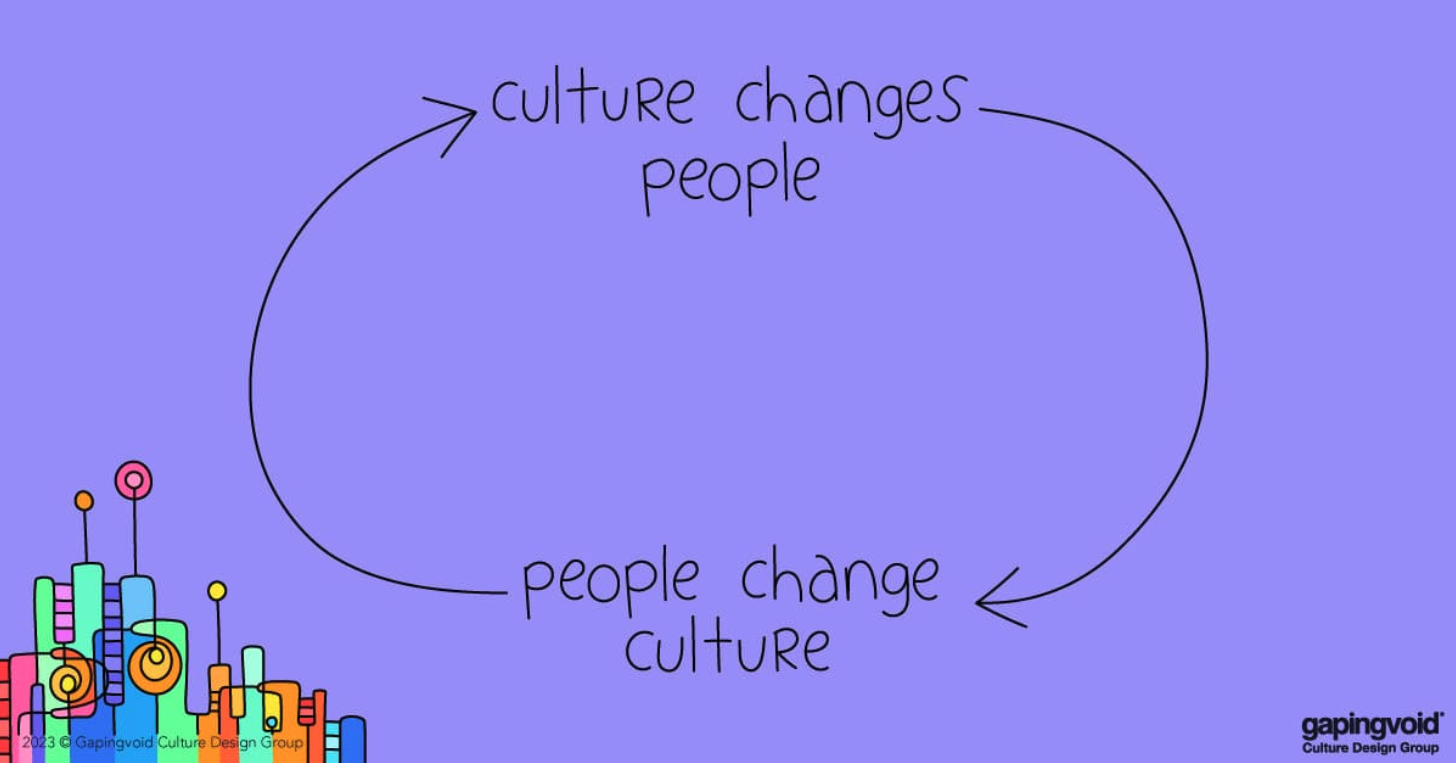
If culture is constantly evolving, culture-building is the ultimate infinite game.
There is no final victory.
There is no state of “We’ve won.”
When you accept that culture is an infinite game, your strategy changes.
You stop looking for one-off solutions and start building dynamic frameworks that allow your organization to continuously listen, adapt, and validate purpose in real time.
The key to playing an infinite game without losing direction is to identify and embed a strong Purpose while constantly assessing how it manifests in daily behaviors.
Purpose leaves traces in what people do when no one is watching. To keep culture alive:
Explore & Revisit: Keep conversations about meaning and direction open across all levels.
Translate to Behavior: Use visual tools and clear frameworks (like canvases) to turn abstract values into actionable, daily choices.
Measure the Unseen: Continuously assess invisible patterns and organizational habits rather than relying on surface-level surveys.
Culture isn’t a destination to reach. It is the bridge that fills the gap between words and actions every single day.