The Moderates of the Apocalypse

How a Czech dissident’s essay about totalitarianism can help leaders understand the most urgent systems failure of our time.
A System Running at a Loss
In any business context, a production system that requires a 16:1 input-to-output ratio would be shut down before the end of the quarter. And yet, exactly this kind of operation runs at the heart of the global food economy, every single day, subsidized by public funds, shielded from market discipline, and largely ignored by institutional leaders.
Every year, humanity extracts approximately 9 billion tons of food from the planet. Roughly 80% of that goes to feed livestock. What comes back is less than one billion tons of meat. Producing a single pound of intensively farmed beef requires 16 pounds of grain, not counting the water needed to irrigate the fields and hydrate the animals. This is not a rounding error. It is a structural contradiction embedded in the foundations of the global food system.
Meanwhile, we raise over 80 billion land animals every year while failing to feed one billion human beings. Meat consumption is concentrated among roughly 17% of the world’s population. The other 6.5 billion people have yet to claim their share of this model. Should they ever try, the planet’s carrying capacity would collapse entirely.

No Separation Based on Form, by Shaun Monson, TEDxPacificAvenue
https://www.youtube.com/watch?v=-P7eopjN92c
How does such a system survive? In Europe alone, 77% of agricultural subsidies, approximately 39 billion euros, flow to the meat and dairy sector, the same sector responsible for over 80% of food-related climate emissions. The system does not survive on merit. It survives on public money. And this rarely appears on the agenda of institutional discussions about sustainability.
Havel’s greengrocer and the architecture of collective denial
To understand why intelligent, informed people continue to participate in and defend this system, it helps to borrow a lens from an unlikely source: Václav Havel, the Czech dissident playwright who became president of his country after helping to dismantle a totalitarian regime from within.
In his 1978 essay The Power of the Powerless, Havel describes a greengrocer who displays a Communist Party slogan in his shop window not because he believes it, but because everyone does, and not doing so would invite trouble.
The sign is not an act of conviction; it is an act of conformity.
And precisely because everyone participates, the illusion acquires the weight of reality.
As Havel observed, the power of the system does not derive from its truth, but from the collective willingness to behave as if it were true.
This framework maps with uncomfortable precision onto the global food system. The sign in the window today is the unreflective assumption that industrial animal agriculture is normal, necessary, and economically rational when in fact it is subsidized, ecologically destructive, and medically damaging.
The fiction is maintained at three distinct levels.
Scientifically, the evidence is solid and published: processed meat carries a Group 1 carcinogen classification from the WHO, on a par with tobacco.
Environmentally, the livestock and dairy industries are among the leading contributors to deforestation, water consumption, and climate emissions, and yet sustainable development summits routinely serve animal products at lunch.
Culturally, eating meat is so deeply embedded in identity, family ritual, and social belonging that questioning it is perceived not as an evidence-based stance, but as a breach of the social contract.
The illusion holds as long as everyone keeps the sign in the window.
The mirror effect: why individual choices carry systemic weight
Here is where the analysis becomes relevant beyond policy and data: at the level of individual behaviour within organizations, communities, and professional networks.
When someone at the table, a colleague, a peer, a client, quietly chooses a plant-based meal, something shifts. Without any declaration, without any judgment, their choice functions as a mirror. It makes visible the fact that the collective fiction is a choice, not a necessity. And that visibility produces discomfort.
Cognitive dissonance theory predicts exactly what follows: faced with the awareness that an alternative exists and that someone nearby is acting on it, others must either revise their own behaviour or intensify their justification for not doing so.
The person who chose differently becomes, in Havel’s terms, the greengrocer who took the sign down, and is often labelled accordingly as a pain in the neck or as a fanatic.
This inversion is worth pausing on. In the current architecture of collective fiction, the person who aligns their behaviour with the scientific and ethical evidence is cast as the radical. Those who perpetuate a system that destroys ecosystems, exacerbates hunger, and harms health are considered moderate and reasonable. The defensive reaction against those who step out of line is not, at root, about food. It is about the discomfort of seeing the illusion crack.
From privilege to justice: a different reframe
There is a language trap that leaders and communicators frequently fall into when discussing these issues: the frame of individual rights. “It is my right to eat a steak“ is not just a defensive reflex; it is a category error.
Rights frameworks assume that one party’s exercise of a freedom does not fundamentally impair another’s.
But when the cumulative exercise of dietary preferences is depleting shared planetary resources, generating climate instability, and deepening global inequality, the “right“ argument collapses under its own weight.
How can the right to a steak coexist with a planet whose resources cannot afford to provide one to all of its inhabitants?
This is the logic of climate justice articulated by thinkers and policymakers across the political spectrum, including in the most recent Global Risks Report 2026 from the World Economic Forum, which identifies extreme weather events, biodiversity loss, and ecosystem collapse as the most severe risks to humanity in the coming decade, while noting that short-term economic logic consistently deprioritizes them.
We live in communities that have worked hard to enshrine respect for minority rights and diverse identities.
Yet the ethical choice to refuse animal products, a choice with profound philosophical, environmental, and moral roots, is routinely dismissed or managed as an inconvenience.
Allergies are accommodated without question. An ethical stance, one grounded in the same scientific literature that informs corporate ESG strategies and institutional sustainability commitments, is treated as an aberration.
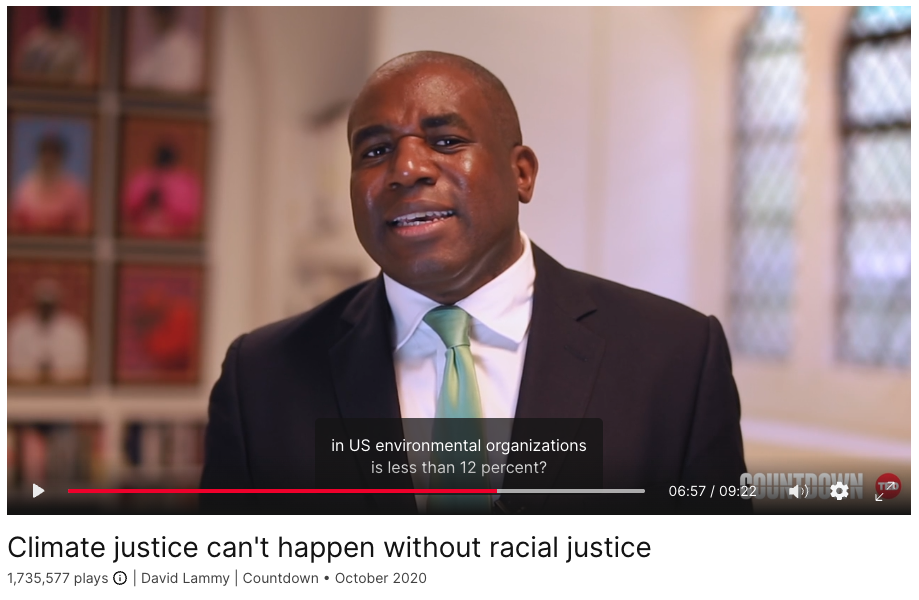
David Lammy at TED Countdown 2020, London: https://www.ted.com/talks/david_lammy_climate_justice_can_t_happen_without_racial_justice
The sign is already coming down
Havel’s insight is ultimately one of hope, not despair. The fragility of collective fictions derives from the same source as their power: collective participation.
As soon as enough people decide to stop performing the role, the illusion begins to dissolve. The greengrocer who removes the sign does not need to march in the street or publish a manifesto. The act of alignment between what one knows and what one does is itself disruptive.
This has direct implications for purpose-driven organizations and their leaders.
The most sophisticated ESG frameworks, the most ambitious net-zero commitments, the most carefully worded statements on food security and biodiversity will carry diminishing credibility if the daily choices made by their signatories contradict them.
Institutional coherence begins with behavioural coherence.
What distinguishes purpose-driven leadership from mere positioning is precisely the willingness to act in alignment with evidence even when that alignment disrupts the comfort of the prevailing collective fiction.
Unlike geopolitical crises or macroeconomic instability, this is a challenge that does not require new international agreements, new legislation, or new technologies. The solution is available to most of us three times a day.
Taking the sign down from the window is the first act. It is also, as Havel understood, one of the most consequential.